skip to main |
skip to sidebar
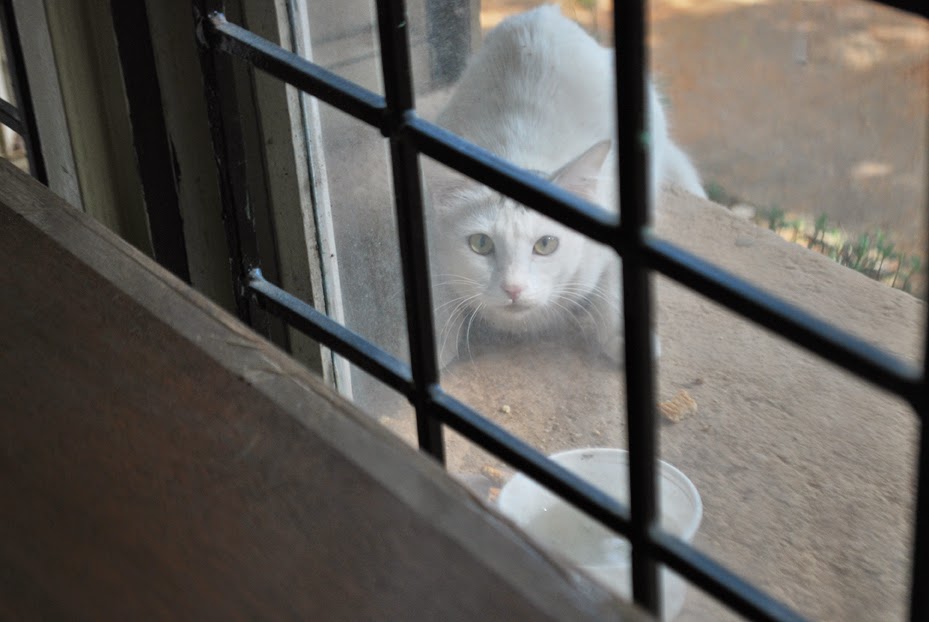
I wonder if the makers of Parle G biscuit realise their brilliance at catering to the universal appetite of animal kingdom. We all have tasted this glucose enriched two rupee pack of baked brick with our tea cups, but to see animals also having a go at it is something else. Yes, dogs can lap it up any day, but squirrels, cats and Myna, all pecking on it day after day, I think we just found a leveling ground in the ecosystem. The most awkward part is Mynas picking up Parle G, even when their Jowar Bajra kept in a bowl. I took a few photographs of the animals coming at my window to munch on some food. Mynas are too camera conscious to let me click a photograph. Here are the fat squirrels (in short, Squatty) and the white cats (there are two of them and both are referred as Mausi).


Watching them eat is one of the selfish reasons to keep the food out. Squirrels roll the Parle G crumbs and Jowar Bajra grains in their tiny hand while running their teeth like a saw on it. You can hear the crackling sound of the grains chipping off into their mouth. A cat on the other hand seems to toss the biscuit in its mouth while eating, each munch of it is like an act of saving the food from falling out of the mouth. They provide a good company through out the day with their wholesome act of eating and getting involved into power games over who gets to eat how much and when. As I type this, I imagine the squirrels hanging out on the window wall like one of the stealth mission of spy movies, probably four of them, waiting for the clearance call on Mausi. And then, they will have a sumptuous breakfast.
After the small success of the post on Common Myna done for Perch Project, Hazel and I decided to get a bit more challenging with the next post. We chose the Domestic Cat as our next animal to be rescued. In the beginning we thought that the availability of information won't be a trouble for this post, but we were overwhelmed by the amount of text. Generally, large amount of instructional text can leave a reader a bit daunted, therefore we opted to break it into charts, worksheet and illustrations that can bring in relief to the reading eye. Hazel being the more knowledgable one, got busy with writing the text, making charts and worksheets, while I had to draw the cat. I knew right from the start that unlike the birds, a furry cat would surely be a lot more difficult. To be honest, I am not a pro at using watercolours, and when doing science illustrations that are meant to be precise and do the job of identifying the drawn subject well, one shouldn't falter. Not to forget, getting the anatomy right is an ardent task too. Some of my initial drawings of the kitten looked like sausages. I kept drawing it day after day but nothing good turned out. Finally, when the time was not in my favour, I decided to cheat by using pencil colours. I console myself over this by telling myself time after time, 'It was all for the right cause.' Here are some of the better ones done during the process -


The final days of putting the Perch post up were pretty crazy. If one goes through our chat history, they would find enough evidence to prove us lunatics. Here's one - 'Also, can we make the poo a bit 3d?'
You can check out the post here. We have also made a facebook page - Perch Project, 'Like' the page if you would like to get future updates from Perch.
You should read Hazel's post too - Domestic Cat on Half Chai.
It was about four months back when I had gone home for a small vacation, I found a baby Myna bird lying on the ground near my mom's car early in the morning. I looked around and couldn't find the nest to put the bird back into. If I had left it over there for long, the ants would have taken care of it. Helpless that I was as I had little knowledge about rescuing a Myna, I called up my friend Hazel who knows about taking care of birds and animals well. I am very sure it's a news in the animal kingdom about which door to knock when in danger, they all end up coming scared, broken and tired to get their nursing done at her place. So after a few calls exchanged, I had some basic idea about the very first things to do when you find a baby Myna. Sadly, the myna didn't survive for more than a day. That's the time when the very first seed of Perch Project was sowed, an idea to create a publication or portal where basic first aid information can be provided to the public about birds and animal rescue commonly found in the urban scenario. Although, there are existing platforms for such information but it's mostly not put in the Indian context. Hence, Hazel and I started investing hours off from regular work to put this blog together called - Perch Project. We have put together the basic details for rescuing a Common Myna as our first post with a few illustrations. We may have missed some things and it will be great help if the readers can bring it to our notice. Feedback is always welcome.

Take a look - http://perchproject.tumblr.com/
We are planning to cover a lot more birds and animals from urban wildlife soon and make it a useful archive for all of the people who want to rescue but don't know how. Lot more hours to steal now for this but I think it will be worth it.